
Interoperability · Decision support
At Boston Children’s Hospital
Maternal–infant health integration and dyad dashboard
Mapped national standards for substance-exposed mother–infant care, then prototyped an interoperable dyad dashboard to use them at the point of care.
- Map
- Standardize
- Build
- Validate
- Role
- Principal Data Scientist and Product Lead
- Outcome
- Data standards framework published in JAMIA (2025); dashboard prototype endorsed for a hospital pilot by HHS stakeholders. Read the paper
- Focus
- FHIR · USCDI · SMART on FHIR · coordinated care · synthetic data · generative AI
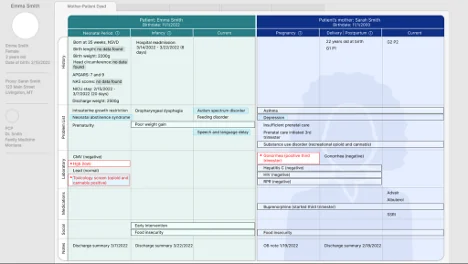
Part A
A data standards framework for mother and infant care
- 180 data elements for substance-exposed mother–infant dyads mapped to national standards, exposing interoperability gaps.
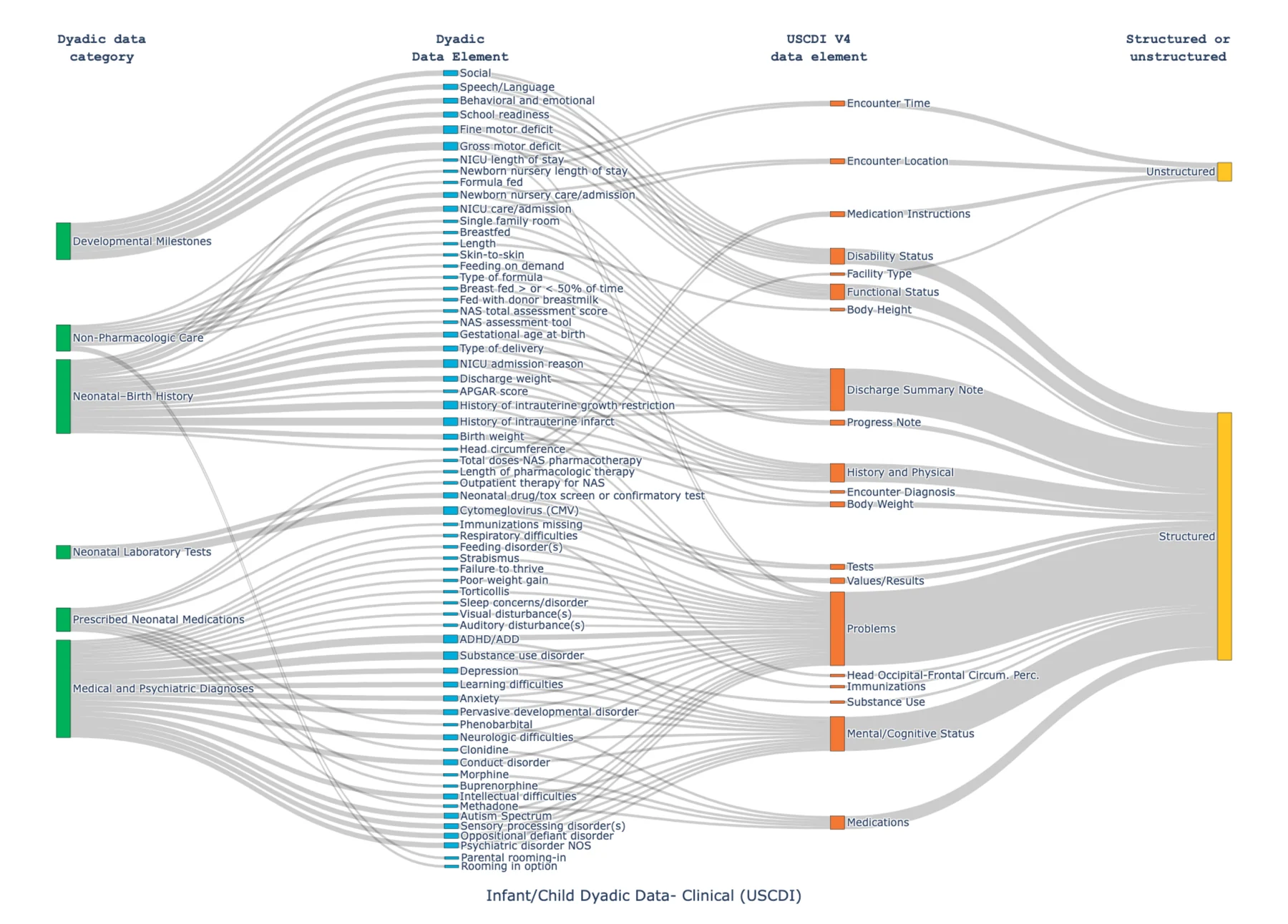
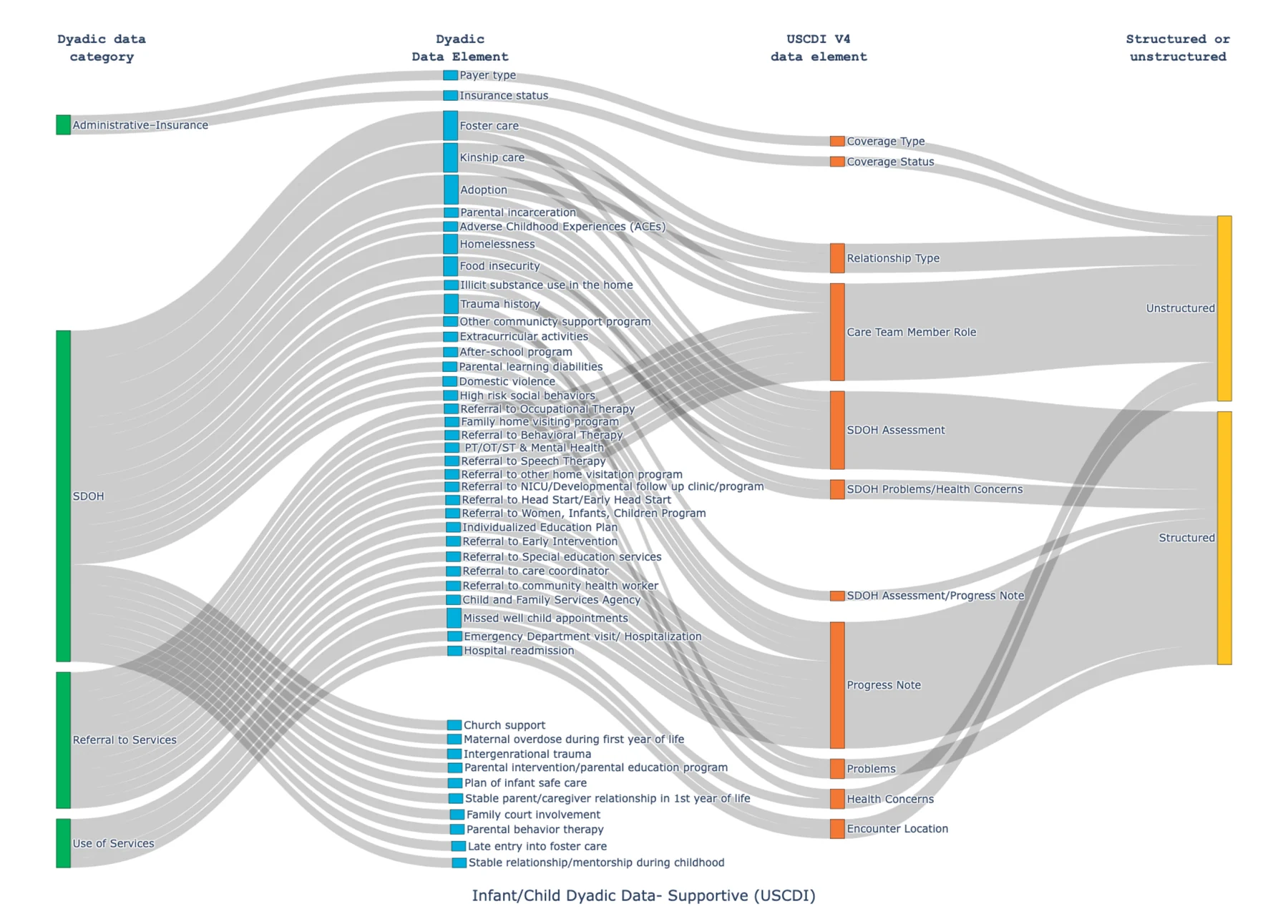
- Over 91% of required dyad data can already flow through USCDI v4 and FHIR R4, so implementation can start now.
- Published in JAMIA (2025), informing federal interoperability guidance for maternal–infant care.
The problem
- Separate maternal and infant EHR systems keep clinicians from seeing the whole dyad when treating substance-exposed families.
- Maternal treatment plans, infant NAS scores and social services involvement lack consistent standard fields.
- Privacy rules and lagging claims data slow exchange, leaving care teams without timely, shareable context.
The solution
- Catalogued 180 clinical and social data elements and mapped each to USCDI and FHIR to quantify coverage.
- Surveyed HIEs and hospitals on current mother–infant linkage and adoption of national standards.
- Wrote recommendations that tell agencies which elements to prioritize for dyad coordination.
Architecture
- Expert review plus Python-assisted lookups to align each element to standard vocabularies.
- A structured HIE survey, analysed quantitatively and qualitatively.
- Sankey charts and coverage dashboards to show where standards succeed.
- Mappings validated with neonatologists, addiction specialists and informaticians.
Results and impact
- Showed most dyad data needs are already covered by national standards.
- Gave implementers a vetted reference in JAMIA.
- Informed ONC equity guidance and an HHS “Dyad Data Tracker” initiative.
| Health data standards | USCDI v4 and FHIR R4; custom dyad requirements mapped to standard fields. |
|---|---|
| Data mapping and scripting | Spreadsheets with Python automation to track coverage and gaps across 180 elements. |
| Survey design and analysis | Targeted HIE surveys on real-world linkage capability. |
| Stakeholder collaboration | ONC, HHS and clinical partners; findings turned into policy guidance. |
| Domain and regulation | NAS scoring, maternal OUD care, HIPAA and 42 CFR Part 2. |
Part B
A dyad care dashboard prototype
- One clinical workspace: a SMART-on-FHIR dashboard that unifies mother and infant EHR data.
- Synchronized context: maternal medications, toxicology and infant withdrawal scores side by side.
- Pilot endorsed: demonstrated with realistic synthetic data, winning stakeholder buy-in for a hospital pilot.
The problem
- Mother and infant records live in different systems, so clinicians toggle between screens during fast decisions.
- Key maternal information is buried in long notes, hard to correlate with infant withdrawal trends.
- Teams rely on manual updates, so dyad insight rarely reaches the bedside in time.
The solution
- A SMART-on-FHIR app that pulls linked mother–infant data into one parallel layout.
- Content and interactions prioritized with OB, NICU and social work teams.
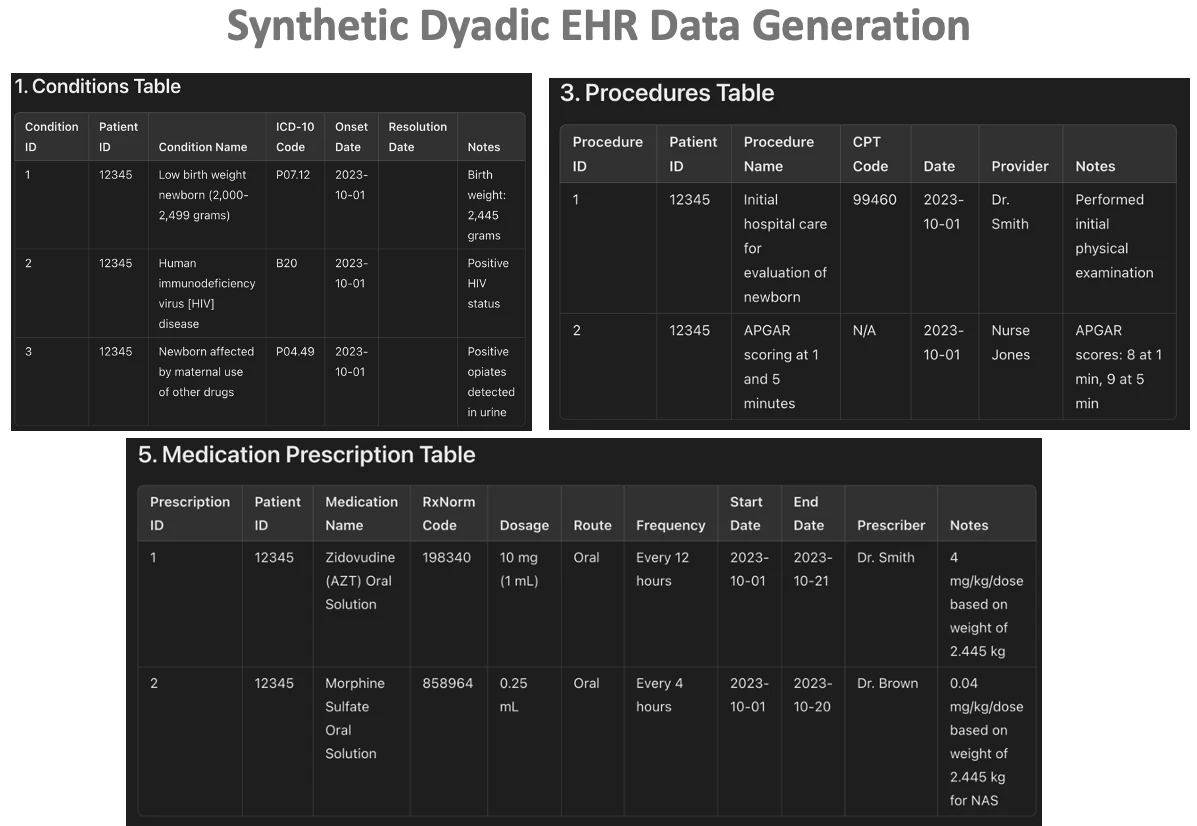
- Realistic synthetic data to show core cases, such as maternal toxicology beside infant NAS trajectories.
Architecture
- Low- to high-fidelity designs in Balsamiq and Figma, grounded in clinician journey maps.
- Front end in HTML, CSS and JavaScript.
- FHIR queries for medications, labs and vitals, pairing records by shared identifiers.
- Synthetic dyad datasets generated with GPT-4 and custom scripts.
- Usability walkthroughs with clinicians shaped layout and highlighting.
Results and impact
- Clinicians saw the value of maternal context beside infant NAS scores right away.
- HHS and hospital leadership endorsed moving to a pilot.
- Prototype code with synthetic FHIR data released for other health systems.
Next step
Records in different systems? Let’s talk.
A free 30-minute discovery call for your team.